Tag: Mutual funds

  • ₹101 a Day: Small Investing Habits That Build Real Wealth

    The ₹101 problem nobody talks about

    Most of us don’t skip investing because we’re careless. We skip it because we’re waiting. Waiting for the next hike, for the loan to end, for the month when there’s “enough” left over.

    That month rarely comes. Expenses rise with income, and the plan to “start properly” keeps moving to next year.

    Here’s a different idea. Start with ₹101. That’s one plate of momos, one auto ride, one food delivery fee and tip. It’s small enough that you won’t miss it, and that’s exactly why it works.

    In this article you’ll see what ₹101 a day can grow into, why small investing habits beat big one-time plans, and seven simple ways to start this week.

    What ₹101 a day can actually grow into

    ₹101 a day adds up to about ₹3,072 a month, or ₹36,865 a year. Invest that regularly and compounding starts working: your returns begin earning returns of their own.

    Here’s what ₹101 a day could become, assuming 8% or 12% yearly returns:

    • After 5 years: you put in ₹1.8 lakh. It could be worth ₹2.3 lakh at 8% or ₹2.5 lakh at 12%.
    • After 10 years: you put in ₹3.7 lakh. It could be worth ₹5.7 lakh at 8% or ₹7.1 lakh at 12%.
    • After 15 years: you put in ₹5.5 lakh. It could be worth ₹10.7 lakh at 8% or ₹15.5 lakh at 12%.
    • After 20 years: you put in ₹7.4 lakh. It could be worth ₹18.2 lakh at 8% or ₹30.7 lakh at 12%.
    • After 25 years: you put in ₹9.2 lakh. It could be worth ₹29.4 lakh at 8% or ₹58.3 lakh at 12%.

    These figures are only examples, not guaranteed returns.

    Look at how the gap grows. In the first five years it’s small. By year 20, you’d have put in about ₹7.4 lakh, but your money could be worth ₹18.2 lakh at 8% or ₹30.7 lakh at 12%. Most of that growth comes in the later years, which is why starting early matters more than starting big.

    Now compare that with waiting. Start 5 years later and you don’t just lose 5 years of deposits. You lose the 5 most powerful years of compounding at the end.

    Why small habits beat big plans

    The money matters, but the bigger win from ₹101 is what it does to your behaviour.

    1. Small is easy to start, so you actually start

    A ₹10,000 monthly goal feels like a project. ₹101 feels like nothing. When the first step is that light, you skip the “I’ll start next month” stage completely.

    2. Daily beats occasional

    Habits are built by repetition, not size. Saving 30 times a month trains your brain far more than saving once. Over time, putting money aside becomes as automatic as checking your phone.

    3. You start seeing yourself as an investor

    Once you have a growing balance, even a small one, your identity shifts. You stop thinking “I’m bad with money” and start thinking “I’m someone who saves.” People who see themselves this way tend to make better money choices everywhere else too.

    4. You stay invested when markets fall

    When the amount is small, a bad month in the market doesn’t scare you into stopping. Staying in through ups and downs is what lets compounding do its work.

    5. It grows with you

    ₹101 is a starting line, not a ceiling. Once the habit is solid, raising it to ₹151 or ₹201 after a salary hike feels natural instead of painful.

    7 small investing habits you can start with ₹101

    1. Automate a daily ₹101 save

    Set it once and let it run. Automation removes the daily decision, and fewer decisions means fewer chances to skip. Pick an app or auto-debit that moves the money before you can spend it.

    2. Swap one small expense

    Find one repeat spend you won’t miss: a second chai, an extra delivery order, an unused subscription. Redirect that exact amount into savings. Your lifestyle stays the same; your balance doesn’t.

    3. Start a small SIP

    Many mutual funds in India accept SIPs from ₹100 to ₹500 a month. Your daily ₹101 adds up to about ₹3,000 a month, enough for one or two SIPs. Read the scheme documents and pick a fund that matches how long you plan to stay invested.

    4. Build an emergency fund first

    Before chasing returns, park part of your daily saving in a safe, easy-to-withdraw option until you have 3 to 6 months of expenses covered. This stops one medical bill or job gap from forcing you to break your investments.

    5. Step up after every raise

    Every time your income goes up, raise the daily amount a little: ₹101 to ₹151, then ₹201. Small step-ups keep lifestyle creep in check and speed up compounding without hurting your budget.

    6. Never miss twice

    Life happens. You’ll skip a day. The rule is simple: one missed day is fine, two in a row is a pattern. Get back on the next day.

    7. Check in once a week, not once an hour

    Look at your balance on a fixed day each week. It keeps you motivated without letting daily market moves stress you out or tempt you to stop.

    Myths and mistakes that keep people stuck

    Myth: “₹101 is too small to matter.” It’s about ₹36,865 a year. Small amounts kept up for years become large ones.

    Myth: “I’ll start when I earn more.” Spending usually rises with income. The habit, not the salary, decides whether you save.

    Myth: “I need to understand markets first.” You need the basics: your goal, your time horizon, and the product you’re using. Learn as you go.

    Mistake: stopping when the market falls. Falls are when your fixed amount buys more units. Stopping locks in the low point.

    Mistake: chasing quick returns or tips. Get-rich-quick tips usually end in losses. Slow, regular investing is boring, and that’s the point.

    Mistake: investing without an emergency fund. One surprise expense can force you to sell at a bad time. Cover emergencies first.

    Mistake: never increasing the amount. ₹101 is the start. Step it up as your income grows.

    How to start this week: a 7-day plan

    1. Day 1: Write down one goal and a date. “₹50,000 emergency fund by December 2027” beats “save more.”
    2. Day 2: Go through last month’s UPI history. Circle one expense you can cut by ₹101 a day.
    3. Day 3: Set up an automatic daily save of ₹101.
    4. Day 4: Decide where the money goes: emergency fund first, then a SIP once that’s covered.
    5. Day 5: Tell one friend or family member. Saying it out loud makes you more likely to stick with it.
    6. Day 6: Set a weekly reminder to check your balance.
    7. Day 7: Look at your first week’s total. That’s proof you can do it. Now keep going.

    Frequently asked questions

    Can I really invest ₹100 a day in India?

    Yes. Many mutual funds accept SIPs from ₹100 to ₹500 a month, and daily saving apps let you put aside small amounts every day. ₹101 a day comes to roughly ₹3,072 a month.

    How much will ₹101 a day become in 10 years?

    You’d put in about ₹3.69 lakh over 10 years. At an assumed 8% to 12% yearly return, that could grow to roughly ₹5.7 lakh to ₹7.1 lakh. Returns are not guaranteed and depend on where you invest.

    Is daily saving better than monthly investing?

    The returns are similar. The difference is behaviour: daily saving builds the habit faster and feels lighter on your budget than one big monthly debit.

    What should I do with my daily savings first?

    Build an emergency fund covering 3 to 6 months of expenses. After that, move towards long-term options like SIPs based on your goals.

    Is ₹101 a day enough to become wealthy?

    On its own, it’s a strong start, not the finish line. The real value is the habit. People who start small and step up their amount over time usually end up far ahead of those who wait to start big.

    The real game-changer is starting

    ₹101 won’t make you rich next month. But in five years it can become a lakh-plus cushion. In twenty years it can become a serious corpus. And from day one it turns you into someone who saves.

    You don’t need a perfect plan or a bigger salary. You need a small amount, a daily habit, and the patience to let time do the heavy lifting.

    Start your ₹101 habit today with Bachatt. Set up your daily save in a few taps and watch small amounts turn into real progress. Download Bachatt

    If this helped, save it for later and share it with a friend who keeps saying they’ll start next month.


    Disclaimer: This article is for education and awareness only and is not investment advice. Figures are illustrative, based on assumed annual returns of 8% and 12%, and are not guaranteed. Mutual fund investments are subject to market risks; read all scheme-related documents carefully. Please consult a SEBI-registered advisor before making investment decisions.

  • Can I Start Investing With Just ₹100 This Dussehra?

    Pooja started her first job eight months ago. Dussehra is a few days away, and her cousin has been telling the whole family that it is a good day to “start something new.” Pooja has ₹3,000 left after rent and bills. She has wanted to start investing for months, but every video she watches talks about lakhs, and she assumes ₹3,000 is too small to count.

    So she does what a lot of beginners do. She downloads three apps, opens a few reels, and closes everything. By evening she has not invested a rupee, and she has seen four people promising her “guaranteed 3% a month.”

    Pooja’s problem has two parts. She does not know how small she can start, and she does not know who to trust.

    How little can you actually start with?

    Much less than most people think. Many mutual funds accept a SIP from ₹100 to ₹500 a month, and the minimum varies by fund. A small amount is a normal way to begin, and plenty of people who now invest regularly started with a figure like this.

    The amount matters less than the first step. ₹100 a month will not change your life this year. What it does is get you through the part that stops most people, which is setting something up and seeing that it works. We covered this in the Week 2 articles: the delay costs more than the small starting amount ever will.

    If Dussehra feels like the right moment, use it. Pick a small number you will not miss, and start this week.

    What is SEBI asking people to watch for?

    This is the part Pooja skipped. SEBI, the market regulator, has asked stock brokers to show investor awareness messages on their websites and trading apps. The circular dated 1 October ties these to its Project Jagrook campaign and World Investor Week 2026, and the messages move onto landing pages from 1 November.

    You do not need to read the circular. The takeaway is simple: the regulator thinks new investors need reminders to be careful. If you are starting with a small amount, that caution applies to you as much as to anyone.

    How do you check who you are investing through?

    Before you put in even ₹100, spend two minutes on these.

    Is the intermediary registered? SEBI’s website lets you search for registered intermediaries. Mutual fund distributors carry an AMFI registration number (ARN), which you can look up on AMFI’s site.

    Is anyone promising a fixed or “guaranteed” return? Market-linked investments, including mutual funds, go up and down. A promise of a fixed monthly return on one of them is a reason to walk away.

    Do you understand what you are buying? If you cannot explain it to a friend in two sentences, wait. A slow start costs you little. A rushed one can cost you the money.

    Is the money you invest money you can leave alone? Keep an emergency buffer first. We covered that in Week 1, and it still comes before any investing.

    What does a sensible first ₹100 look like?

    Keep it plain. One fund, one small SIP, one fixed date each month. Skip the trading tips and the group chats. If the price drops in month two, nothing has gone wrong, because small and regular amounts are made for that.

    Over a year, ₹100 a month is ₹1,200 of contributions. That is the money you put in, and it says nothing about what it will be worth, since market-linked investments can rise or fall. Once the habit holds, you can raise the amount, which is a few taps in most apps.

    Pooja sat down with her phone that evening, closed the reels, and picked one amount. Then she checked that the platform and the distributor were registered, which took about five minutes.

    That check is the step Bachatt cares about most. Bachatt helps first-time investors start with mutual funds, from Insta FD for money you want to withdraw anytime, to Wealth baskets and Gold & Silver funds. Check the minimum amount for each option in the app before you begin, because it differs. Mutual fund investments are subject to market risk, so read all scheme-related documents carefully.

    Pooja started her SIP on Dussehra. She told her cousin about it the next day, and he asked how small was too small. Her answer was that small enough to keep doing was the right size.


    Mutual fund investments are subject to market risk. Please read all scheme-related documents carefully before investing. This article is for informational purposes and does not constitute investment advice. Bachatt is operated by Trusave Fintech Private Limited (AMFI ARN-321640).

  • Chapter 1: Mutual Fund Investment Landscape

    Chapter 1: Mutual Fund Investment Landscape

    While we try to answer some of the below questions that the investors ask:

    “Which mutual fund schemes should one buy this year?”

    “Which is the best mutual fund scheme?”

    “Which is the best investment?”

    “Should I invest in stocks or real estate?”

    “What is your view of the stock market?”

    “Are my investments proper? Or should I make some changes?”

    We often overlook the investor needs while trying to answer such questions. Before trying to choose the right mutual funds, or any other instrument for your investment, you need to understand the investors’ needs first.

    • Financial Goals: Investments are linked to financial goals like children’s education, retirement, or buying a house.
      • For example, Shalini’s parents want to support her dream of becoming a space scientist, which requires financial planning for her education.  
    • Goal Setting: Prioritize goals based on importance and timeline (short-term vs. long-term).
      • Rabindra, an engineer, is planning for his retirement, a long-term goal. Surinder Singh wants to buy a house in the near future, a short-term goal.  

    Seven Habits of Highly effective people (by Stephen R Covey)

    UrgentNot Urgent
    Important
    Not Important

    Important but not-so-urgent tasks are not planned for in time until they become urgent.

    • Inflation: Account for inflation, which erodes purchasing power over time.
      • For instance, if Shalini’s higher education costs Rs. 50 lakhs today, it will cost significantly more in 10 years due to inflation.  (₹ 1,07,94,625 after 10 years)
      • While a future expense will depend on a lot of factors like course/university selected, but it is important to keep a baseline expense adjusted for inflation
    • Savings vs. Investments: Saving is setting aside money, while investing aims to grow it.
      • Saving is considered akin to ensuring the safety of money, 
      • Investment is done primarily with the objective of earning profit.  
    • Investment Factors: Evaluate investments based on:
      • Safety (risks involved),
      • liquidity (ease of converting to cash), 
      • returns (income or capital gains), 
      • Convenience (ease of investment, ease to take out money, check value of investments),
      • ticket size (minimum investment),
      • Taxability (lower tax, more tax before maturity),
      • Tax deductions (e.g. ELSS)
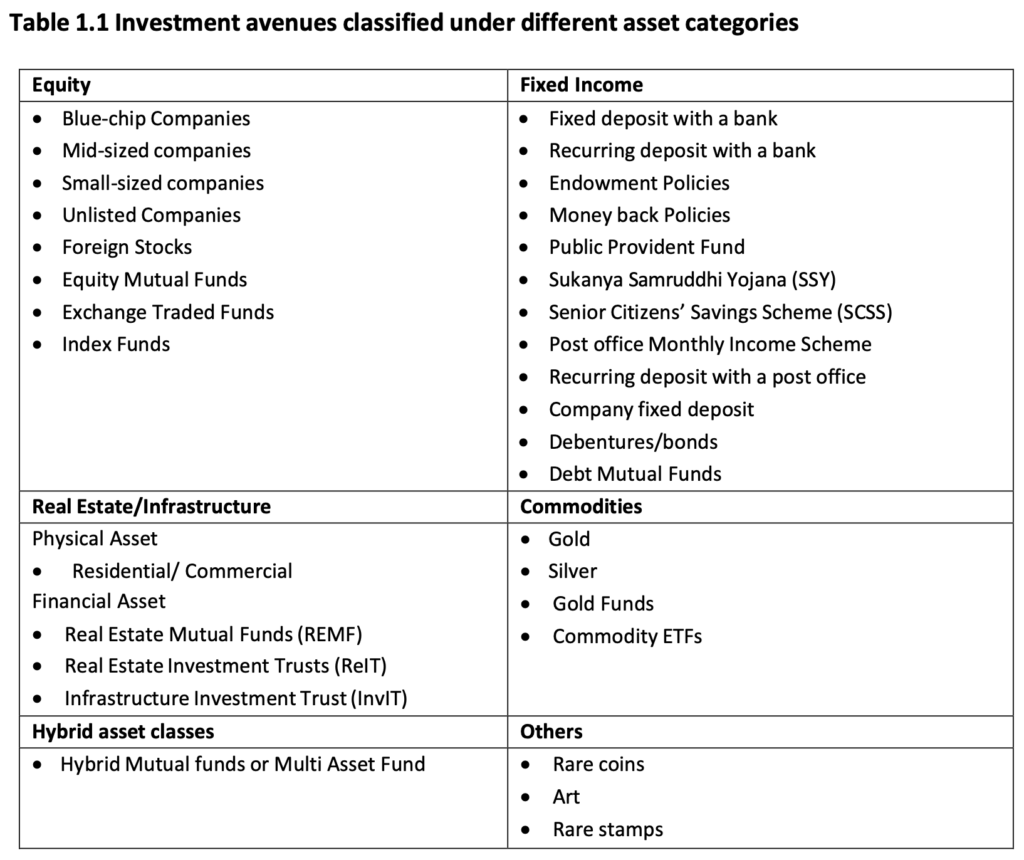
    • Asset Classes: Major asset classes include real estate, commodities, fixed income, and equity.
      • Real Estate:
        • In majority of cases, individuals purchase real estate for self-occupation
        • Can be for self-occupation or investment, but location is critical, and it’s relatively illiquid.  
      • Commodities:
        • Commodity contracts – largely short term contracts, allows large exposure with small money
        • Includes gold and silver, which can be used as investment avenues.  
      • Fixed Income:
        • Includes bonds and debentures, which can provide regular income.  
        • If person holds bonds till maturity, in almost all cases, there would be no capital gains
        • A transaction on bonds in secondary market – capital gains or losses
      • Equity:
        • Represents ownership in a business and carries risks and potential for higher returns.  
        • Equity share prices fluctuate a lot. However, over long periods of time, the share price follows the growth of the company. Historically, equity investing has generated returns in excess of inflation
        • Equity share owners also receive dividends from the company
    • Investment Risks: Mainly includes – Inflation risk, Liquidity risk, Credit risk, Market risk and Price risk
      • Inflation Risk:
        • For example, if inflation is 8% p.a., Rs. 10,000 today will be worth only Rs. 6,800 in purchasing power after 5 years. 
      •  Liquidity Risk:
        • Government securities offer safest investment, but to realise them without capital gains, need to hold them till maturity
        • Low liquidity in real estate, pre-mature withdrawal penalty in FDs 
      • Credit Risk:
        • Issue of bond does not pay or pay with delay
      • Market Risk and Price Risk:
        • Market Risk: When the price of all securities in a market falls due to a macro event like war, etc.
        • Industry specific risk/First specific risk
      • Interest Rate Risk:
        • Interest rate Increases, Bond prices fall
        • Drop in interest rate, increases value of investment
        • Longer maturity Instruments = More fluctuations
    Risk ManagementDiversification and asset allocation are key strategies for managing risk.
    – Avoid: Avoid certain instruments based on your risk profile.
    – Speculate: Take a position based on a certain expected event in the market, like falling interest rates.
    – Diversify: Diversification involves spreading investments across different asset classes to reduce risk.
    Behavioral BiasesBe aware of biases like overconfidence, herd mentality, and loss aversion, which can negatively impact investment decisions.

    For example, investors may miss out on critical information due to reliance on immediate examples or experiences.
    Asset AllocationDiversify investments across different asset classes to balance risk and return.

    Strategic asset allocation aligns with an individual’s financial goals, considering factors like return requirements, time horizon, and risk profile.

  • How to select the Right Mutual Fund

    How to select the Right Mutual Fund

    Navigating the world of mutual funds can be overwhelming with the numerous options available in the market. As an investor, understanding how to select the right schemes based on your investment goals is crucial for building a successful portfolio. In this guide, we’ll explore the key factors to consider when choosing mutual fund schemes.

    Understanding Investment Strategies

    The foundation of any mutual fund selection process begins with understanding different investment strategies and how they align with your financial goals.

    Active vs. Passive Funds

    • Passive funds (index funds, ETFs) aim to mirror benchmark indices with lower expense ratios
    • Active funds seek to outperform benchmarks through strategic stock selection
    • The trade-off: Active funds offer potential for higher returns but come with higher costs and the risk of underperformance

    Open-Ended vs. Close-Ended Funds

    • Open-ended funds provide liquidity with redemption at NAV but face the risk of fluctuating assets
    • Close-ended funds may offer higher return potential but have limited exit options before maturity
    • Consider your liquidity needs when choosing between these structures

    Diversification Spectrum

    Different funds offer varying levels of diversification:

    • Diversified funds (Multi-cap, Large-cap, Mid-cap) spread investments across sectors
    • Focused funds concentrate on fewer stocks, increasing potential returns but also risk
    • Sector funds invest in a single sector, carrying higher concentration risk
    • Thematic funds invest across sectors but follow a specific theme, offering moderate concentration

    Market Capitalization Strategy

    • Large-cap funds invest in established companies with stable revenues and lower risk
    • Mid-cap and small-cap funds target growing companies with higher risk-reward potential
    • Multi-cap and flexi-cap funds provide exposure across market segments

    Growth vs. Value Approach

    • Growth funds target companies expected to grow faster than average (higher risk)
    • Value funds seek undervalued stocks with price appreciation potential

    Specialized Fund Categories

    Debt Fund Options

    • Fixed Maturity Plans (FMPs): Close-ended debt funds with fixed maturity periods
    • Target Maturity Funds (TMFs): Open-ended alternatives to FMPs with high-quality securities
    • Short Duration Funds: Lower volatility options for 1-3 year horizons
    • Liquid and Ultra-Short Term Funds: Lowest risk options for very short-term parking of funds
    • Floater Funds: Options with steady NAVs despite interest rate fluctuations

    Hybrid and Alternative Options

    • Hybrid Schemes: Combination of debt and equity exposures for balanced portfolios
    • Dynamic Asset Allocation: Adjusts allocations based on market conditions
    • Gold Funds: Include ETFs tracking gold prices or funds investing in gold mining companies

    Evaluating Fund Performance and Management

    When comparing mutual fund schemes from different AMCs, consider:

    Fund Manager Expertise

    The fund manager’s experience and track record in identifying market trends can significantly impact performance.

    Performance Metrics

    • Compare returns relative to the benchmark over extended periods
    • Look for consistent outperformance in both bull and bear markets
    • Use cumulative returns data to evaluate different holding periods
    • For equity funds, focus on longer performance periods

    Portfolio Analysis

    • For equity funds: Check diversification, market segment exposure, cash holdings, and turnover
    • For debt funds: Evaluate portfolio maturity, credit risk profile, and interest vs. capital gains contribution

    Operational Factors

    • Fund age: Longer history provides better evaluation data
    • Fund size: Consider in context of investment universe (large for large-cap, smaller for mid/small-cap)
    • Portfolio turnover: High turnover may indicate higher costs and unsteady management
    • Expense ratio: Especially important for debt schemes and index funds

    Making the Final Selection

    Research Resources

    • Understand rating agency methodologies when reviewing their rankings
    • Remember that historical performance doesn’t guarantee future results
    • Consider the impact of taxes and exit loads on actual returns

    Choosing Scheme Options

    • Growth option: Allows compounding within the fund without annual taxation
    • Dividend payout: Provides regular income but depends on distributable surplus
    • Dividend reinvestment: Automatically reinvests distributions
    • Consider systematic withdrawal plans (SWPs) as an alternative to dividend payouts for regular income needs

    Conclusion

    Selecting the right mutual fund scheme requires careful consideration of your investment goals, risk tolerance, and time horizon. By understanding the different fund categories, evaluating performance metrics, and aligning investment strategies with your financial objectives, you can build a portfolio that works effectively toward your long-term financial success.

    Remember that diversification across fund types, regular monitoring, and periodic rebalancing are essential practices for maximizing your mutual fund investments over time.

  • Categorisation of Mutual Funds

    Categorisation of Mutual Funds

    SEBI Circular on Categorisation and Rationalisation of Mutual fund schemes, 2017

    SEBI has categorized all Mutual funds in 5 Broad categories:

    • Equity Schemes (11 sub-categories)
    • Debt Schemes (16 sub-categories)
    • Hybrid Schemes (6 sub-categories)
    • Solution Oriented Schemes (2 sub-categories)
    • Other Schemes (2 sub-categories)

    Equity Schemes (11 schemes)

    Multi Cap FundsMin 25% in Large Cap companies (1 – 100th company)Min 25% in Mid Cap companies (101st – 250th company)Min 25% in Small Cap companies (251st company onwards)
    Large Cap FundsMin 80% in Large cap companies
    Large & Mid CapMin 35% in Large + Min 35% in Mid
    Mid Cap FundsMin 65% in Mid Cap
    Small Cap FundsMin 65% in Small Cap
    Dividend Yield FundsMin 65% in equity + Majority in dividend yielding stocks
    Value Stocks or Contra FundMin 65% in equity stocksValue fund = Value Investment StrategyContra fund = Contrarian Investment Strategy
    Focussed FundMaximum 30 Stocks + Min 65% in equity
    Sectoral/ThematicMin 80% in equity of a particular sector
    ELSSStatutory lock-in of 3 years and tax benefitsMin 80% investment in equity
    Flexi-CapMin 65% investment in equityVaried investment across large, mid and small cap stocks

    Debt Schemes (16 schemes)

    All of the below debt schemes are Open-ended

    Overnight FundOvernight securities having maturity of 1 day 
    Liquid FundDebt and money market securities having maturity of 91 days (T-bills, bank bonds, etc.)
    Ultra short duration FundDebt and money market securities with Macaulay duration of portfolio between 3 to 6 months 

    Macaulay formula = Wtd avg time to receive a bond’s cash flows
    C = Coupon rate
    M = Maturity value

    Macaular Duration formula
    Low duration FundDebt and money market securities with Macaulay duration of portfolio between 6 months to 1 year 
    Money Market FundMoney market instruments with maturity up to 1 year
    Short Duration FundDebt and money market securities with Macaulay duration of portfolio between 1 to 3 years 
    Medium Duration FundDebt and money market securities with Macaulay duration of portfolio between 3 to 4 years
    Medium to Long Duration fundDebt and money market securities with Macaulay duration of portfolio between 4 to 7 years
    Long Duration fundDebt and money market securities with Macaulay duration of portfolio more than 7 years
    Dynamic bondInvesting across durations
    Corporate Bond FundMin 80% investment in AA+ and above rated corporate bonds
    Credit Risk FundMin 65% investment in AA and below rated corporate bonds
    Banking & PSU FundMin 80% investment in Bank and PSU debt instruments
    Gilt FundMin 80% investment in G Secs across maturity
    Gilt Fund with 10 yrMin 80% investment in G Secs so that Macaulay duration of portfolio is 10 years
    Floater FundMin 65% investment in floating rate instruments

    Hybrid Schemes (6 schemes)

    Conservative Hybrid Fund75-90% in debt instruments10-25% in equity and equity instruments
    Balanced Hybrid Fund40-60% in equity and equity related instruments40-60% in debt instrumentsNo arbitrage permitted
    Aggressive Hybrid Fund65-80% in equity and equity related instruments20-35% in debt instrumentsNote: Mutual funds in India can offer either Aggressive Hybrid Fund OR Balanced Fund
    Dynamic Asset Allocation/ Balanced AdvantageInvestment in equity/debt managed dynamically
    Multi Asset AllocationInvests in at least 3 asset classesMinimum 10% allocation in each asset classForeign securities not treated as separate asset class
    Arbitrage FundMinimum 65% in equityInvests in arbitrage opportunities
    Equity SavingsMinimum 65% in equityMinimum 10% in debtInvests in equity, arbitrage and debt

    Solution-Oriented Schemes (2 schemes)

    Retirement FundLock-in of 5 years or till retirement (whichever is earlier)For long-term retirement corpus planning
    Children’s FundLock-in of 5 years or till child’s majority (earlier of two)For building corpus for child’s future needs

    Other Schemes (9 schemes)

    Index Funds/ETFsMinimum 95% in securities of a specific index being tracked
    Fund of Funds (Overseas/ Domestic)Minimum 95% in underlying fund
    Fixed Maturity PlansClose-ended debt fundsPortfolio duration aligned with scheme maturity
    Target Maturity Date Funds (TMF)Debt funds with specific maturity dates (2-10 years)Invest in bonds with matching maturities
    Capital Protection Oriented FundsClosed-end hybrid fundsPart investment in debt instruments for capital protectionRemaining in equity derivatives for higher returns
    Infrastructure Debt FundsMinimum 90% in debt securities of infrastructure companies/projectsCan be set up as Trust (regulated by SEBI) or Company (regulated by RBI)
    Real Estate Mutual FundMinimum 75% in real estate assets, mortgage-backed securities, equity sharesAt least 35% in physical assetsClosed-end and listed on stock exchange
    ESG FundsSub-category under thematic equity schemesVarious strategies: Exclusion, Integration, Best-in-class, Impact investing, etc.
    Specialized Investment Fund (SIF)Minimum investment amount: Rs. 10 lakhs